How Honda Activated 94% of Its Retailers for Online Campaigns with socialPALS
Cases-EN
How Honda Activated 94% of Its Retailers for Online Campaigns with socialPALS
Cases-EN
In the motorcycle segment, brick-and-mortar retail is the decisive place for consultation, test rides and final purchase decisions. That is exactly why brands face the following question: How can digital visibility in the local market be achieved without retailers having to take on additional work and complexity?
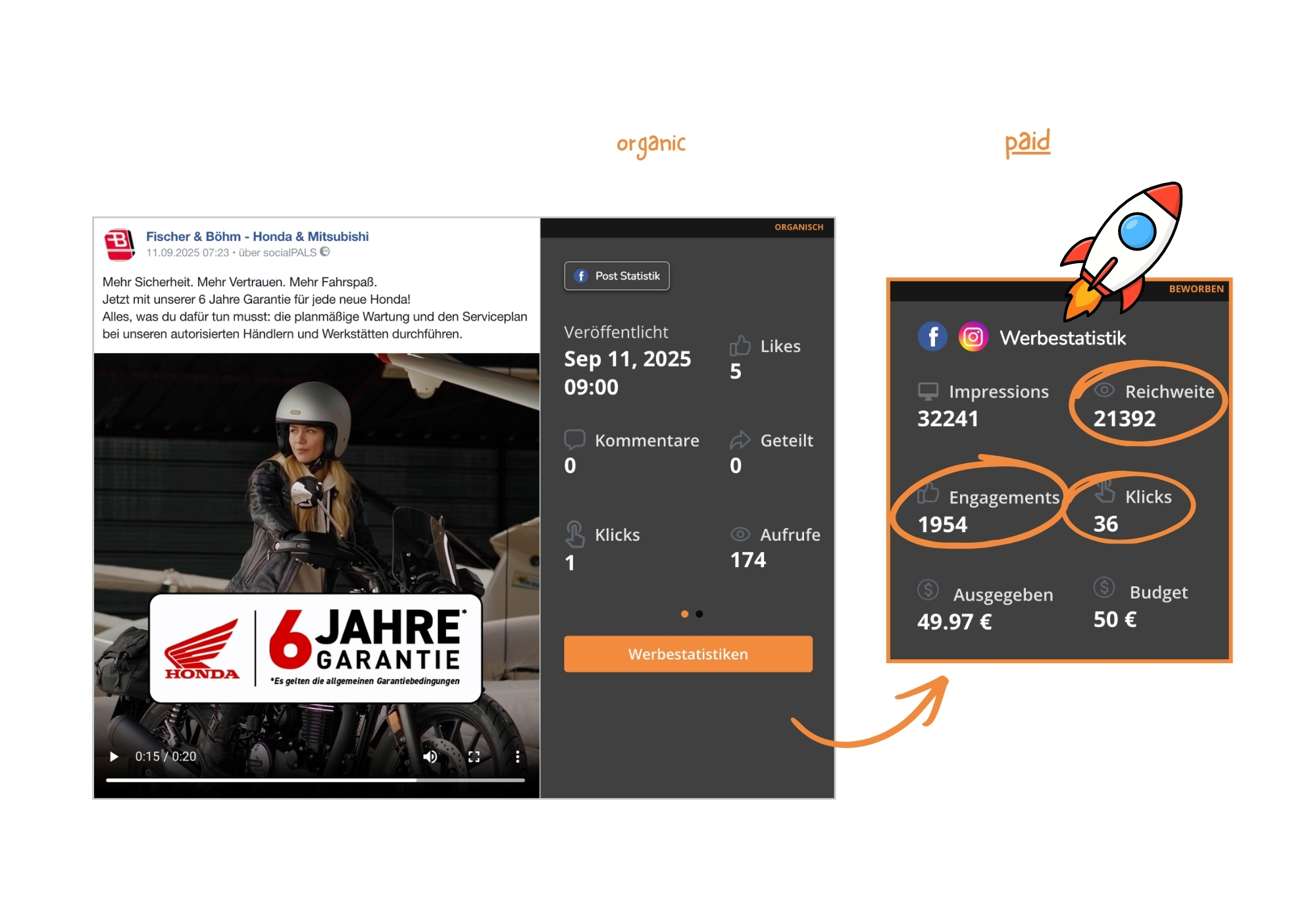
Honda Motorcycles chose a clear, scalable approach and rapidly onboarded its retailer network together with socialPALS: 164 out of 175 retailers are already connected, corresponding to an onboarding rate of 94%. And participation in the very first campaign already significantly exceeded expectations: 131 retailers joined instead of the originally projected 50.
In this interview, Filip De Clippel explains how Honda centrally manages content and guardrails, how operational scaling into the retailer network works, and why personal support is a key success factor.
Filip De Clippel Department Manager Marketing & Product Management Motorcycle | Honda Germany
Filip, please briefly introduce yourself: What was your path to Honda – and what role and responsibilities do you have at Honda Motorcycles today?
I joined Honda after various positions in the motorcycle and marketing sector, where I learned a great deal about how closely brand, product and retail are connected. Today, I am responsible for the marketing and product management areas at Honda Motorcycles. My focus is on positioning our models and topics correctly in the market and building visibility together with retail – in a way that ensures measures not only “look good”, but also provide concrete support for retailers.
What role does brick-and-mortar retail play in your marketing strategy?
For us, brick-and-mortar retail is a central part of the customer journey because consultation, test rides and final purchase decisions take place on site. Accordingly, we do not see marketing only as brand communication, but also as support for our retailers in the local market. Digital visibility is an important factor here so that retailers are already present early on during customers’ orientation phase.
Where do you currently see the greatest pressure in the retailer network, especially when it comes to digital marketing?
Many retailers know that social media is important, but time, personnel and know-how are limited. That is exactly where things can quickly become difficult. In addition, many businesses are going through a generational change, which does not automatically solve digital topics. Retail needs solutions that work, can be implemented quickly and do not create additional stress.
What triggered the decision to start with socialPALS and what goal did you have in mind for Honda?
We wanted to provide concrete support for retail in sales while also achieving comprehensive digital visibility without every retailer having to reinvent the wheel. We were looking for a solution that is simple, reliable and scalable. That exact combination is why we got started with socialPALS.
How important is it in the motorcycle segment to be visible already during the orientation phase – before someone is specifically searching for a model or requesting a test ride?
Extremely important – especially with motorcycles, the decision-making phase is longer and strongly driven by emotion. Many interested customers get inspired, compare models and gather impressions before they actively start searching or planning a test ride. If our retailers are locally present during this phase, familiarity is created: people see the bike, the offer or the roadshow in their own surroundings – and when the time comes for the next step, the nearest Honda location is already top of mind.
You develop content, messages and timing yourselves. What exactly does socialPALS take over and what consciously remains with Honda?
Honda defines the guardrails: messaging, offer logic, visual world, timing and approvals. socialPALS takes over the operational scaling into the retailer network: onboarding, local delivery and reporting. This means that management and brand image clearly remain with us – while at the same time making things as easy as possible for retailers without requiring us internally to support every location individually.
What were the typical objections at the beginning (internally and from retailers) – and what created trust the fastest?
Typical objections were additional effort, uncertainty regarding social media and concerns about brand consistency. Trust came quickly through two things: first, the simplicity – only a few steps were needed to participate. Second, the personal guidance: retailers had direct contacts who could help immediately instead of everything running through tickets or complex tools. That significantly lowered the barrier to entry.
You had planned rather conservatively at the start. What actually happened during retailer onboarding?
To be honest, I would already have been satisfied if we had activated 50 retailers at the start. In the first campaign, 131 retailers participated right away. That was a very clear signal. Overall, we have now onboarded 164 out of 175 retailers, which means a 93.7% onboarding rate. For me, that is the best proof that the model works in practice.
Voices from the trade:
“What I found particularly positive about the Honda campaign was that I practically had no effort at all myself: the campaigns were already fully prepared – that saves me an enormous amount of time and supports sell-through. The platform is also ideal for anyone without social media know-how: it is very easy to use and offers all the necessary levers to achieve good reach. Content and features are professionally designed to increase reach and gain new followers. Personal support was also really, really good: settings were adjusted in the account quickly, and you are always reminded in a friendly way if you happened to overlook an email. Particularly helpful was also the information that the free brand budget can alternatively be used for Google Ads so that it does not expire – especially if no Facebook or Instagram account is available.”
If you explain it in terms of a realistic retailer day-to-day business: Which tasks are specifically eliminated – and what does the retailer gain as a result?
What disappears: planning content, writing copy, technically setting up ads, adapting image formats, coordinating regular posts and dealing with platform updates. What retailers gain: continuous local visibility in professional quality, CI compliant – and above all, more time for sales, test rides, customer contact and workshop business.
How can you concretely tell that local visibility supports sell-through, and which signals are most important to you?
We mainly look at practical indicators: more response to promotions, more local reach in relevant catchment areas, increased interactions and – particularly important – qualitative signals from retail, for example when customers specifically refer to content or events. In the motorcycle segment, this is a strong indicator because visibility and inspiration often happen before a concrete inquiry.
Many brands know tools that ultimately feel as if users are “left alone.” What makes the personal support from socialPALS so decisive for you?
Because retailers do not need yet another platform where they end up stuck in a ticketing system if they have questions. socialPALS is not just a tool, but a partner that picks retailers up where they are, regardless of how digitally advanced they are. If there are questions or difficulties, someone is available, reacts quickly and solves things pragmatically. That is exactly what keeps retailers active.
What has changed internally for you through this setup – organizationally and in the collaboration between marketing and sales, and how do you measure that?
We have fewer individual operational coordination loops because the setup is standardized. Marketing can roll out campaigns consistently, while sales has an activation-ready offer for retailers – with clear mechanics and reporting. At the same time, management also benefits because with existing budgets we can reliably generate reach and presence and make the impact traceable. Overall, implementation is faster because there is less friction: content is prepared, delivery is scaled, and retailers no longer need to be individually “convinced” but can simply get started.
Looking ahead: What are the next development steps? More active retailers, more continuity, more measurability or more local budgets – and why?
The next step is primarily to further strengthen continuity and keep even more retailers active – because that is exactly what creates presence in the market. At the same time, measurability is important so that we can make the internal case even more clearly. And in the longer term, we see potential in local budgets: once retailers see that the mechanism works, a natural willingness emerges to locally extend or strengthen individual campaigns.
If you had to give another motorcycle brand one piece of advice: In your view, what is the most important success factor for strengthening retail digitally without overwhelming it?
Strengthening retail digitally only works if it is made as easy as possible for retailers while still remaining CI compliant. The decisive factor is a setup that is scalable, runs continuously and relieves retailers in their day-to-day work – combined with personal guidance so that nobody feels “left alone.” That is exactly how you achieve real participation, remain visible in the local market and create a structure that has a long-term effect.
Conclusion
Honda demonstrates very clearly what matters in retail marketing today: local visibility that works without creating additional effort for retailers. The comprehensive rollout across the network and the strong participation already in the first campaign clearly show that a scalable setup in motorcycle retail is not only possible, but is also embraced in practice.
For brands that sell through a retailer network, this is exactly where the lever lies: manage content centrally, deliver it locally, make it measurable and at the same time ensure through personal support that retailers remain active.
Voices from the trade:
“We always use the budget for ads provided by Honda and are very satisfied with the results. The same goes for the pre-prepared, professional posts, which make campaign execution significantly easier for us. The platform also proves itself in day-to-day business: it is very easy to use, all relevant data is already automatically stored for new campaigns, and the entire process runs in an automated way. That noticeably saves us time. And if something does not work smoothly, personal support is always available and helps quickly and easily.”
socialPALS brings brands and retail partners together, creating a win-win situation that unleashes previously untapped potential. The innovative software solution simplifies complex processes through automated retail marketing and strengthens stationary retail through regional brand campaigns. Get your obligation-free platform demo today and become part of the socialPALS success story.
Our team is happy to show you the plattform with no obligations: