Vitra has been one of Europe’s most defining design brands for over seventy years. The Swiss family business based in Birsfelden has been working since 1950 with the most important designers of our time, from Charles and Ray Eames to Verner Panton and George Nelson to Hella Jongerius, Antonio Citterio, and Barber Osgerby. Its products are sold exclusively through authorized specialist dealers. Since 2022, socialPALS has been helping Vitra make this dealer network – now spanning nine European countries – locally visible, without brand integrity ending at the shop counter.
In this conversation, Sven Wehlmann, Managing Director of Vitra Germany, talks about why good dealer marketing is no side issue for a design brand, why local visibility only works with clear brand governance, and why timing in marketing ultimately comes down to attitude and consistency.

Sven Wehlmann
Managing Director | Vitra Germany
A Chance Encounter at OMR
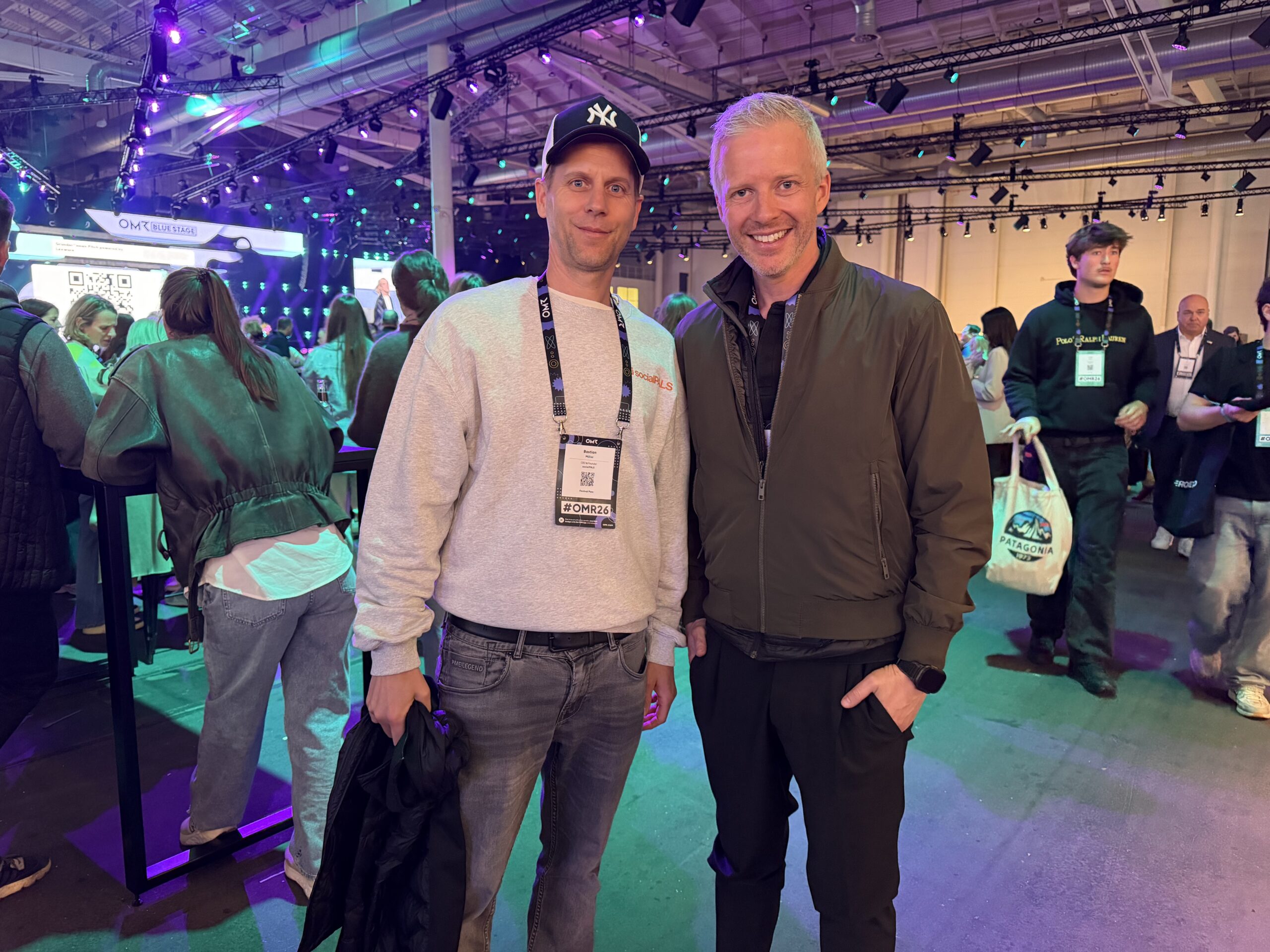
Bastian Müller: Sven, we’ve known each other through Vitra and socialPALS for years, but we only actually met in person for the first time a few weeks ago at OMR in Hamburg. What stuck with you from that conversation?
Sven Wehlmann: Honestly, the meeting was very brief. Two minutes of small talk, and then we were straight into the topics that occupy us at Vitra anyway: How is the premium specialist trade developing? How does a brand stay cleanly managed when it’s consistently sold through dealers? And how do we make sure local visibility doesn’t come at the expense of the brand? That’s exactly what I value about working with socialPALS. It doesn’t feel like “we’re buying a platform” – it feels more like two teams working on the same question. That’s a big difference.
From that conversation at OMR, the idea quickly emerged to tell this story properly to the outside world. Hence this interview.
“It’s not about another tool. It’s about solving a real trade and brand challenge together.”
Bastian Müller: Vitra has been one of the world's most defining design brands for over seventy years. Why does a brand with this kind of standing need external support in dealer marketing?
Sven Wehlmann: Because a strong brand isn’t automatically strongly visible everywhere. Vitra made a deliberate decision to sell exclusively through authorized specialist dealers. That’s part of how we understand our brand. An Eames Lounge Chair, a Panton Chair, or an Anagram sofa need expert advice, context, and a place where you can experience the quality firsthand. But that’s exactly where a responsibility comes in. When customers start their journey digitally today – and they almost always do – Vitra also needs to be cleanly visible locally, digitally. Not just at our campus in Weil am Rhein, but in Munich, Vienna, Antwerp, or Lisbon. If our dealers aren’t present there, we’re missing a crucial touchpoint together.
So our visibility doesn’t just happen centrally – it happens very concretely on the ground, at the dealer level. If that local presence doesn’t work, the dealer loses the first point of contact, and we lose a piece of the brand experience.
Bastian Müller: What was the reality of dealer marketing before you started with socialPALS in 2022?
Sven Wehlmann: Very traditional. We produced good content – images, copy, media kits – and handed it over to dealers. After that, it varied widely. Some dealers used it brilliantly. Others let it sit unused. Not because they lacked motivation, but because there’s real effort involved in getting from a PDF in an inbox to a properly executed local campaign.
Many of our partners don’t have their own marketing department. They advise customers, plan projects, hold consultations, put together quotes. And even when something was posted, the reach was often modest. Organic alone makes it very hard to gain ground in the market today if it isn’t set up professionally.

Bastian Müller: Does that mean the old model – brand sends content, dealer posts it – simply doesn't work anymore?
The old model assumed dealers would simply take on the marketing work as well. In reality, their energy rightly goes into sales, consultation, and project work. That’s where their strength lies. That’s exactly why we want to provide social media campaigns – especially for dealers without a marketing department – in a way that works without every dealer having to become a campaign manager.
“Dealers shouldn’t have to become campaign managers. They should be able to make Vitra locally visible – simply, cleanly, and on brand.”
Bastian Müller: Vitra has an extremely precise brand world – from the logo to the visual language built up over decades alongside its design classics. What happens to that precision when 100 dealers across nine countries are communicating at the same time?
Sven Wehlmann: That was the most critical point for us from the very beginning. A design brand can’t afford to look arbitrary anywhere along the line. If an ad runs locally and the logo is positioned wrong, the image is cropped poorly, or the typography doesn’t fit, the customer doesn’t think “that was the dealer.” For them, it’s Vitra.
That’s why it was clear to us: brand governance stays centralized. Things only become local where locality genuinely adds value – location, point of contact, proximity to the showroom, concrete directions. But visual language, layout, tone, and quality have to come from the brand.
Bastian Müller: How does that work in practice – how much can an individual dealer actually change in a campaign?
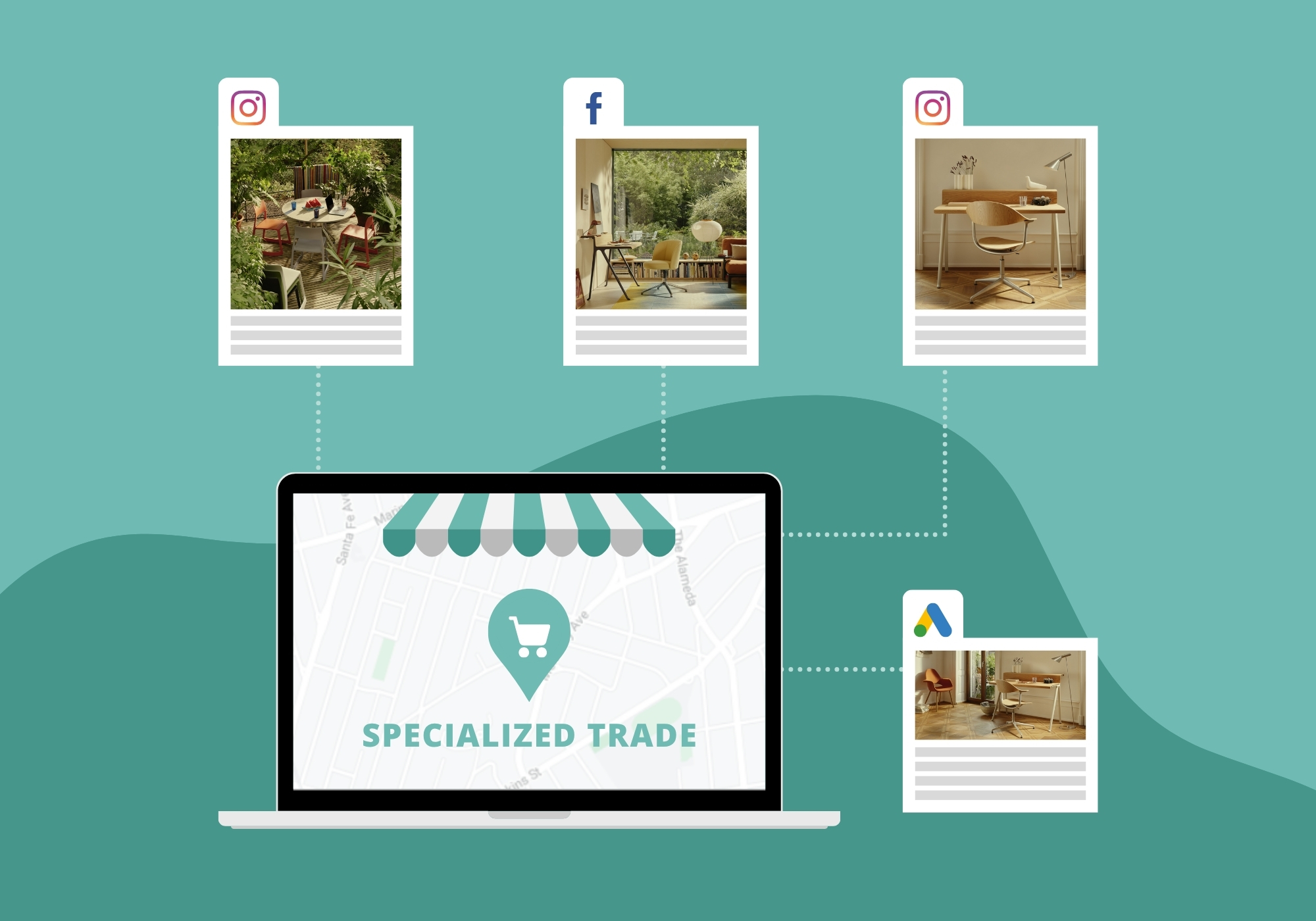
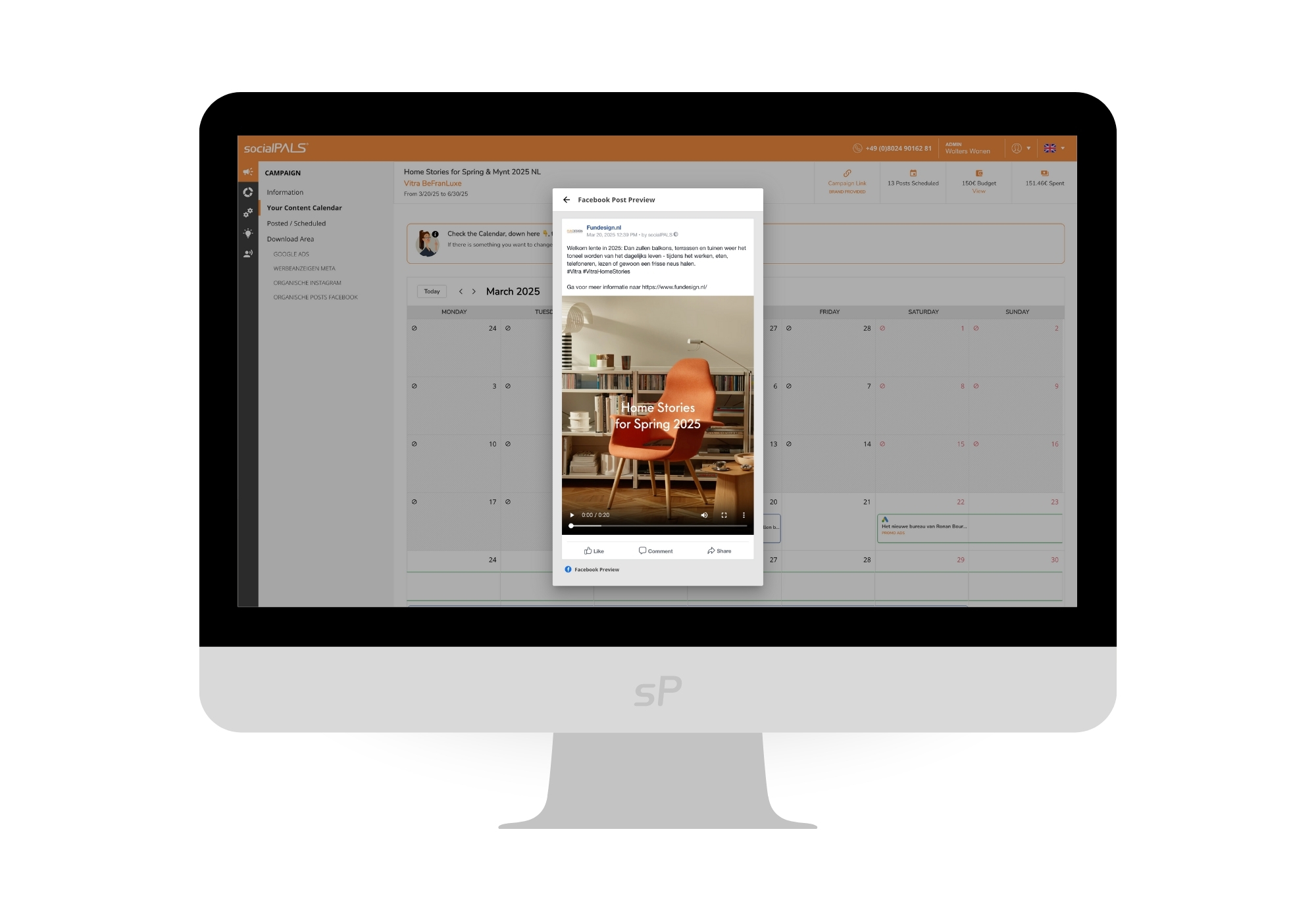
Sven Wehlmann: First, the dealer decides whether to take part in a campaign. Once activated, the posts and ads provided by Vitra are automatically published on their channels at the defined time – for example on Facebook, Instagram, and LinkedIn. For Google Display, the dealer’s name and logo are added. The ads then typically run within a sensible radius around the location, usually around 20 to 30 kilometers. We also work with campaign-specific landing pages, where the dealer is clearly featured – with logo, location, and the respective Vitra campaign. This way, it’s never an anonymous brand presence, but a clear connection between Vitra and the local dealer.
What matters is this: the visual framework comes from us. Image composition, visual language, grid – that stays with Vitra. There’s room for flexibility where it makes sense: in the copy, in local references, or in the dealer’s own positioning. Many dealers actually find this a relief. They don’t want to have to decide every time what Vitra should look like. They want it to look good and work.
“Yes to locality – but where it adds value. Not in visual brand governance.”
Bastian Müller: Why is this consistency so important for a brand like Vitra economically, not just aesthetically?
Sven Wehlmann: Because the brand doesn’t just work through product quality, but through credibility. Design quality, longevity, heritage, expert advice, culture – these are essential for us. That standard has to be tangible at the touchpoint.
If a campaign looks arbitrary, the brand becomes a bit more arbitrary too. And that’s when the price discussion tends to start much faster. For a brand, that’s a real business risk. So it’s not about whether an ad looks “nice.” It’s about whether it upholds the price promise and the brand promise.
Bastian Müller: Vitra works with a design philosophy that you yourselves describe as "two business partners on a shared search for the best solution," rather than a client-contractor model. Can this mindset also be applied to the way you work with your specialist dealers?
Sven Wehlmann: Yes, very much so. Our work with designers is always a partnership: we provide a framework, but the best solution emerges together. We apply that same understanding to our dealer network. Our dealers aren’t simply points of sale. They carry Vitra into cities and into customer conversations where we ourselves aren’t present every day.
And that’s exactly the mindset we expect from partners who work with us on these kinds of topics. A platform that ignores our brand logic and says “that’s just how it’s done” wouldn’t work for Vitra. socialPALS understood that this is about our system, our dealers, and our brand quality. That was decisive for me.
“Our dealers aren’t just sales partners. They’re the places where Vitra becomes locally tangible.”
Bastian Müller: Many brands plan their brand presence very precisely – seasonal waves, launches, trade fair moments. How important is it for a dealer network to move in sync with that rhythm?
Sven Wehlmann: Very important. At Vitra, we think in communication waves: Home Stories for Spring, Home Stories for Winter, product launches, limited editions, designer moments. At those times, the brand has a clear international focus. And the dealer network needs to move in sync with that.
If the central presence is strong but nothing happens locally – or something completely different happens – a disconnect occurs. The customer sees a clear winter world from us, then finds something random, or nothing at all, at the local dealer. That’s exactly the disconnect we wanted to close.
Voices from the Specialist Trade:

Susanne Schreiber-Beckmann
Interior Design / Sales – Inside Sales
Bastian Müller: How do you manage this in practice with socialPALS today?
Sven Wehlmann: We define the timing, message, visual world, formats, budget logic, and distribution centrally. Dealers decide whether to take part. If they’re in, their campaign runs in sync with the Vitra campaign – in the same visual language, but locally around their location.
That’s the real lever. When we launch a winter campaign, the same brand wave runs in parallel across many cities, with the respective dealer as the local anchor. The customer in Cologne sees Vitra and the Cologne dealer. In Vienna, the same thing happens for Vienna. We’re not simply communicating more. We’re communicating in a more coordinated way.
“The difference isn’t volume. The difference is synchronicity.”
Bastian Müller: What role do paid ads play in this setup, and how do you prevent advertising budget from flowing in the wrong direction locally?
Sven Wehlmann: A major role. We have to be honest: organic reach alone is no longer a reliable strategy for premium brick-and-mortar retail today. Higher visibility only comes through paid – via Meta, Google Display, and similar channels. But we didn’t want every dealer to have to learn how to use an ads manager.
Through socialPALS, the dealer gets a predefined package: target audiences, radius, formats, budget, and timing are all set according to our specifications. The dealer doesn’t need to handle the technical management – they just decide whether to take part. For us, that means: brand identity stays clean, the right audiences are reached, and the budget works where it’s supposed to – locally around the dealer.
Bastian Müller: You now work with socialPALS across nine European markets. How do you make sure a campaign stays high-quality everywhere while still fitting each market's reality?
Sven Wehlmann: By setting up the logic cleanly once, and then making it adaptable for each country. The campaign doesn’t need to be reinvented in every market. Countries can translate it, adapt dealer structures, and account for local specifics where it makes sense.
The point isn’t to communicate exactly the same way everywhere. The point is not having to start from zero everywhere. That saves time, reduces complexity, and still keeps quality high.
“For me, internationalization doesn’t mean making everything identical. It means creating a strong logic that works cleanly at the local level.”
Bastian Müller: Do you have any figures that show how this international synchronization translates into activation?
Sven Wehlmann: The Home Stories for Winter campaign in the DACH region shows this very well: a broad base of dealers takes part. Many individual showrooms become visible within the same period, in the same visual world – each one local, with its own landing page and Vitra branding.
For me, the key factor isn’t the sheer scale. It’s the consistency. We were able to run this wave without any deviations in the brand world. With the traditional approach of sending out content packages and coordinating individually with each dealer, achieving that level of quality would hardly have been realistic.
Voices from the Specialist Trade:

Sascha Wilkesmann
Managing Director
Bastian Müller: You've also run workshops with socialPALS – the Vitra Digital Day in Belgium, sessions in Amsterdam. Why invest in in-person meetings when the platform itself runs digitally?
Sven Wehlmann: Because despite all the digital tools, our business remains a relationship business. Dealers want to understand what they’re actually activating. They want to see what their campaign looks like, when it runs, what they can influence themselves, and where the brand sets the framework.
You really notice this at formats like the Digital Day in Belgium or the sessions in Amsterdam. As soon as a dealer truly understands and experiences their first campaign, the perception shifts. “Just another tool” becomes “this actually helps me.” That kind of translation work isn’t something you can achieve through email alone.
Bastian Müller: After three years of working together, what do you specifically value about socialPALS, and where do you see the difference compared to classic MarTech platforms?
Sven Wehlmann: The most important point is that socialPALS didn’t impose a ready-made, one-size-fits-all logic on us. We have requirements that matter for a design brand: image quality, brand governance, tone, international control, local activation. These points were taken seriously.
Concretely, for me it comes down to three things. First, the visual quality stays Vitra. Second, there’s a direct, personal line to the team – not an anonymous hotline, but real points of contact. Third, we can scale internationally without complexity exploding. That combination is what makes the difference.
Bastian Müller: Last question. If you were speaking today with another premium or design brand that hasn't yet systematically activated its dealer network in digital marketing, what would you tell that brand?
Sven Wehlmann: I would say: the days when brands and dealers could communicate digitally as two separate things are over. The customer doesn’t make that distinction. For them, the local dealer is either part of a professional brand presence – or not.
If, as a brand, I leave my dealer network alone digitally, I shouldn’t be surprised when my brand promise weakens exactly where the customer is about to make their decision. At the same time, the whole thing has to remain scalable. You can’t carry 100 dealers individually through every campaign. You need a model that connects central brand governance with local activation: synchronized, high-quality, and simple enough that the dealer doesn’t need their own marketing department for it. Then the specialist trade becomes a strength. Without such a model, it can quickly become a weak point.
“Whoever cleanly connects central brand governance with local activation turns the specialist trade into a strength. Whoever doesn’t, leaves an important interface exposed.”
Act now and use MDF more effectively!
socialPALS brings brands and retail partners together, creating a win-win situation that unleashes previously untapped potential. The innovative software solution simplifies complex processes through automated retail marketing and strengthens stationary retail through regional brand campaigns. Get your obligation-free platform demo today and become part of the socialPALS success story.